
The Science of Saltwater Intrusion and Food Security
By Garrett Zhou
Imagine fertile farmland near the coast slowly transforming into something closer to the ocean floor. Crops don’t disappear overnight — they grow weaker, shorter, and less productive. This phenomenon costs farmers billions in lost yields and arable land each year, and its primary driver is saltwater intrusion. With over 40% of the world’s population living near coastlines, the threat of contaminated water supplies looms as a daily reality for hundreds of millions of people (Stanford).
What Is Saltwater Intrusion?
Saltwater intrusion is the encroachment and infiltration of saline water — whether brackish or full seawater — into the fresh surface water and groundwater supplies of coastal areas (Britannica). Its effects are far-reaching: it alters landscapes, degrades agricultural land, and contaminates the freshwater supplies that communities depend on. The problem is already acute in countries including China, the United States, Italy, and Bangladesh.
Why Does It Happen?
The most significant driver of saltwater intrusion is rising global sea levels. Since 1880, the global average sea level has increased by 24 centimeters, and the rate of rise doubled during the 21st century to approximately 0.1 inches per year (Britannica). But sea level rise is only one part of the picture.
Climate change also increases the frequency of extreme weather events. Floods and storm surges can push seawater miles inland, threatening areas that historically had no saltwater exposure. Paradoxically, drought-stricken regions face equal danger: when soil becomes severely parched, it absorbs salt more readily, as there is no freshwater present to flush it out.
Human activity compounds the problem. In coastal communities, over-extraction from wells reduces freshwater pressure in aquifers, creating a vacuum that saltwater rushes in to fill. This form of intrusion is preventable — but only if communities manage their water resources carefully (Britannica).
Effects on Soil, Health, and Food Security
In agricultural zones, saltwater intrusion can trigger freshwater salinization syndrome, where elevated salt concentrations increase the mobility of other soil pollutants. Freed nitrogen and other nutrients leach into waterways, reducing crop yields and causing eutrophication — a process in which runoff chokes aquatic ecosystems with excess nutrients (Britannica).
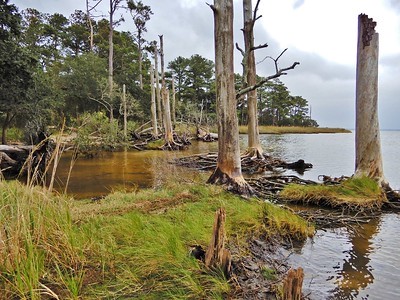
Beyond agriculture, high soil salinity destabilizes riverbanks, increasing flood frequency, and causes land subsidence — the gradual sinking of the ground. Coastal forests are also at risk of widespread die-off.
For human health, the consequences are serious. Prolonged exposure to elevated sodium levels stresses the kidneys and is associated with hypertension, heart disease, and dementia. The World Health Organization sets the safe threshold for drinking water salinity at 200 ppm; the U.S. EPA sets its standard even lower, at 60 ppm (Britannica).
Spotlight: Bangladesh
Few countries illustrate the human cost of saltwater intrusion as starkly as Bangladesh, ranked the 9th most vulnerable nation to climate change in 2024. An estimated 20 million coastal residents are affected by increased water salinity, and in the dry season, local pond water — a primary drinking source — becomes undrinkable. Even imported water often contains unsafe salt concentrations, putting communities across 19 coastal districts at risk.
Atiq Rahman, executive director of the Bangladesh Center for Advanced Studies, has noted that rising sea levels and coastal inundation have caused water and soil salinity in Bangladesh’s coastal areas to increase to alarming levels — a direct consequence of global warming (Global Health Now).
The crisis has a pronounced gender dimension. Because shrimp farming is more profitable than rice cultivation, many farmers have converted their fields into saltwater shrimp ponds. Women who wade into these saline ponds to collect baby shrimp face disproportionate health consequences: in southwest Bangladesh, more than half of women in affected areas reported reproductive tract infections, and more than 1% underwent uterectomies as a result of health complications stemming from saline exposure (Global Health Now).
Potential Solutions
Combating saltwater intrusion will require a coordinated mix of public policy and private innovation. Existing responses in Bangladesh include rainwater harvesting, pond sand filters, and desalination facilities, along with charitable organizations distributing clean drinking water. These measures, while valuable, are largely reactive rather than preventative (Global Health Now).
Addressing the three core impacts — drinking water contamination, structural erosion, and farmland degradation — requires targeted strategies (Britannica; USDA Climate Hubs):
Drinking water: Reverse osmosis and desalination plants, freshwater import pipelines, and expanded water storage infrastructure.
Structural erosion: Coastal sea walls and erosion-control plantings have proven effective in stabilizing vulnerable shorelines.
Farmland damage: Farmers are experimenting with salt-tolerant crops such as barley in place of more sensitive staples like corn. Land that has already been lost to salinity can be repurposed for conservation, wildlife habitat restoration, and native plantings — all of which help reduce erosion and sequester carbon.
Conclusion
Saltwater intrusion is an uphill battle that is only getting steeper. As global temperatures rise, sea level increases and extreme weather events will intensify, making prevention harder and remediation more expensive. Many current drivers — over-pumped wells, saltwater aquaculture ponds, and inadequate coastal management — are human-caused and therefore correctable. But even as those behaviors are addressed, the deeper challenge of climate change demands coordinated global action. The fields are already turning saline. The window for prevention is narrowing.
Works Cited
Britannica, The Editors of Encyclopaedia. “Saltwater Intrusion.” Encyclopaedia Britannica, Encyclopaedia Britannica, Inc., http://www.britannica.com/science/saltwater-intrusion.
“Silent Killer: Saltwater Threatens Women’s Health in Coastal Bangladesh.” Global Health Now, Johns Hopkins Bloomberg School of Public Health, May 2024, globalhealthnow.org/2024-05/silent-killer-saltwater-threatens-womens-health-coastal-bangladesh.
Stanford Doerr School of Sustainability. “Understanding Saltwater Intrusion Through Remote Sensing.” Stanford Sustainability, Stanford University, sustainability.stanford.edu/news/understanding-saltwater-intrusion-through-remote-sensing.
United States Department of Agriculture. “Saltwater Intrusion and Salinization of Coastal Forests and Farms.” USDA Climate Hubs, United States Department of Agriculture, http://www.climatehubs.usda.gov/hubs/southeast/topic/saltwater-intrusion-and-salinization-coastal-forests-and-farms.


Leave a Reply