
By Garrett Zhou
Ever looked in the fridge and seen nothing there? Probably not. However, the reason for that is likely not what you are thinking. Many people believe that how much you make, or income, is the determining factor between food insecurity and food security. However, another factor has been proven to have greater statistical significance than income: location. That’s right. Where you live matters more than how much you make. If you read for the next 3-4 minutes, you’ll understand the underlying issue here as well.
Needless to say, food insecurity is a huge problem. Over 47 million Americans experienced it in 2023, the highest number ever. However, lines on a map can indicate whether the fridge is empty or full. According to Feeding America, 20% of children across the US experience food insecurity. Pretty high, right? However, the number is estimated to be roughly 50% in rural areas. Additionally, over 85% of the counties with the highest rates of food insecurity are rural. 90% of the counties with the highest rates of food insecurity are in the South. We see the pattern. Certain regions are more severely affected by hunger, and your mistake might not be your spending habits, but your zip code.
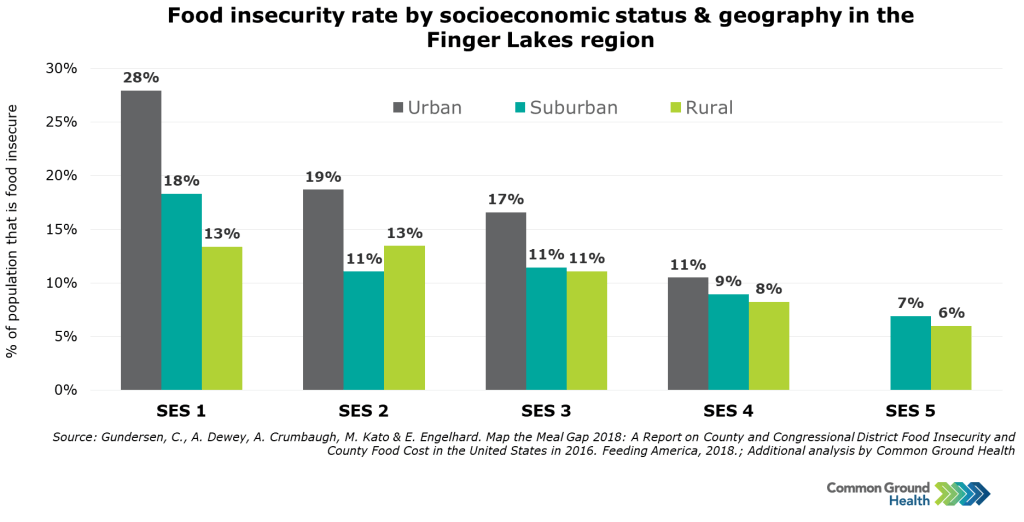
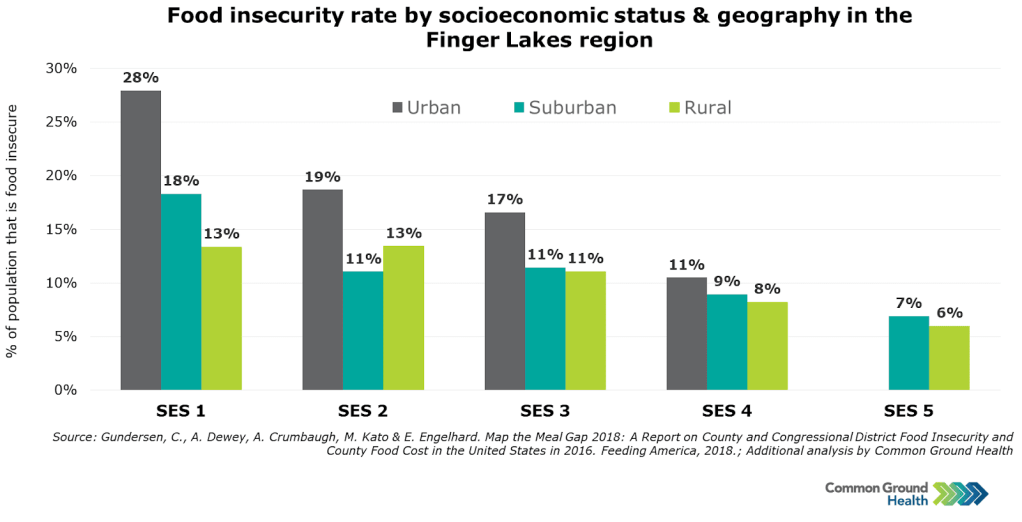
However, the pattern of rural counties being more food insecure doesn’t hold everywhere, even though it’s the general trend. In the Finger Lakes region of New York, urban zip codes had the highest rates of food insecurity, while rural codes had the lowest.
However, in central Texas, a study conducted by UT Austin professors concluded that residents in rural zip codes had greater odds of making a 2-1-1 call, which often regards food needs. The researchers also found that having a supermarket in your zip code, which is exponentially more likely in an urban zip code compared to a rural one, is a deciding factor in the number of 2-1-1 calls made. The solution indicated in the study read: “the development of food insecurity mitigation programs in peri-urban and rural areas is needed.”
Regardless of whether urban or rural zip codes have higher rates of food insecurity, the fact that your location can significantly impact your access to food still holds. That’s why I am currently conducting a research project investigating the predictive causes of hunger around the world and illustrating findings. It will get published soon. If you have any inquiries about my research project, please feel free to email me at garrettzhou09@gmail.com.
Regardless of whether urban or rural ZIP codes experience higher rates of food insecurity, the central takeaway is the same: location powerfully shapes access to food. Factors like grocery store density, transportation, local wages, and community infrastructure vary widely by ZIP code, meaning two households with similar incomes can face completely different food security outcomes. In many cases, food insecurity isn’t about whether food exists—it’s about whether people can reasonably reach it. This makes hunger a structural issue, not just an individual one.
Understanding hunger through a geographic lens helps explain why national averages often miss the real problem. Hunger is not evenly distributed; it clusters in specific communities. That’s why mapping food insecurity at the ZIP code level is so important—it allows resources, policy, and intervention to be targeted where they’re needed most. This perspective also drives my current research, which focuses on identifying the predictors of undernourishment and forecasting future hunger hotspots. Hunger is not random. It’s predictable, and recognizing the role of place is a crucial step toward a Better Tomorrow.
Bibliography
“Feeding America’s ‘Map the Meal Gap’ reveals stark disparities in rural child hunger.” Feeding America, 14 May 2025, http://www.feedingamerica.org/about-us/press-room/Map-the-Meal-Gap-2025?.com. Accessed 31 Jan. 2026.
“Food Insecurity by Socioeconomic Status & Geography.” Common Ground Health, commongroundhealth.org/insights/library/food-insecurity-by-socioeconomic-status-geography?.com. Accessed 31 Jan.2026.
Janda, Kathryn M., et al. “Mapping Food Insecurity-Related 2-1-1 Calls in a 10-County Area of Central Texas by Zip Code: Exploring the Role of Geographic Food Access, Urbanicity and Demographic Indicators.” Journal of Community Health, vol. 46, no. 1, 23 May 2020, pp. 86-97. NIH. https://doi.org/10.1007/s10900-020-00847-3. Accessed 31 Jan. 2026. Abstract.


Leave a Reply